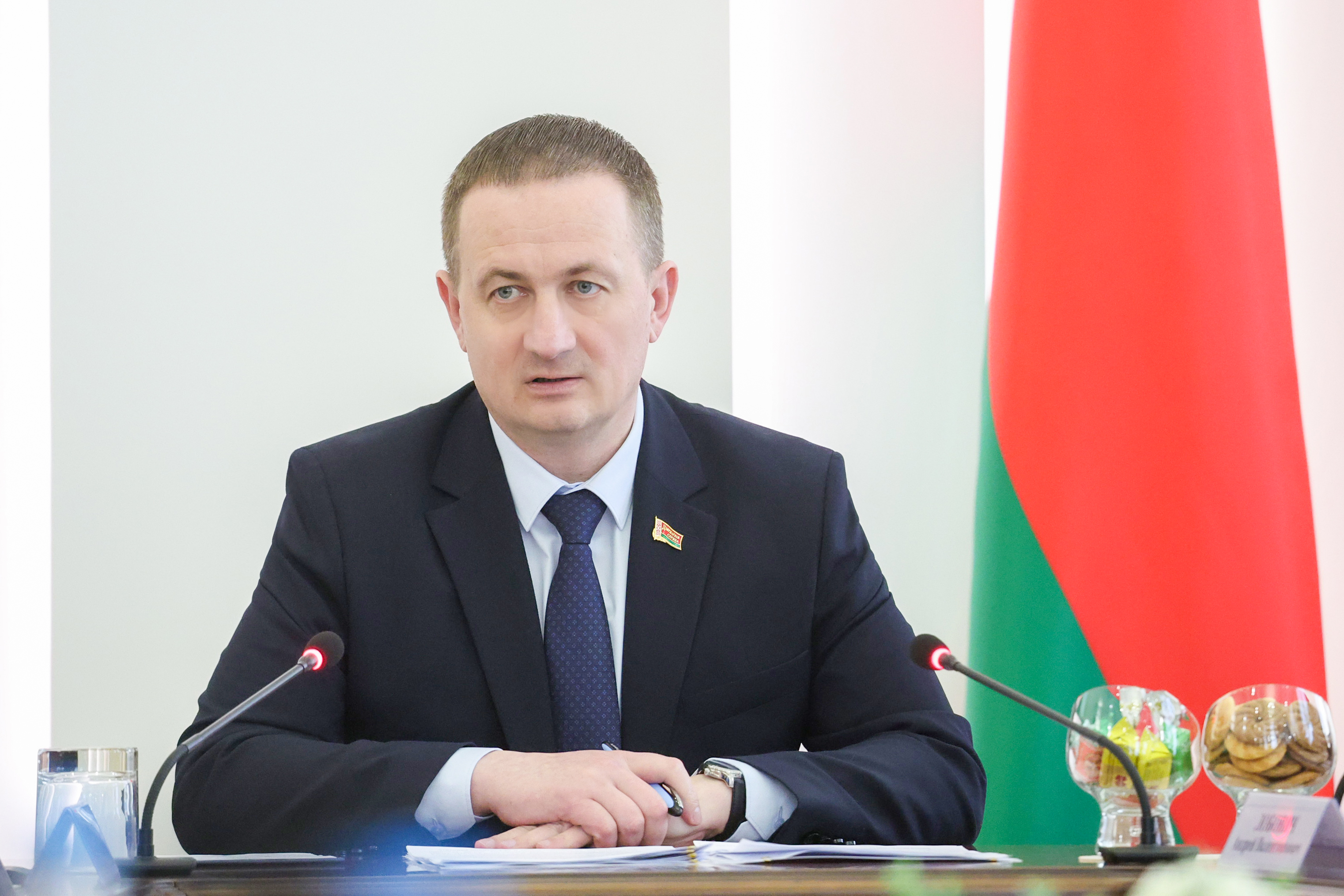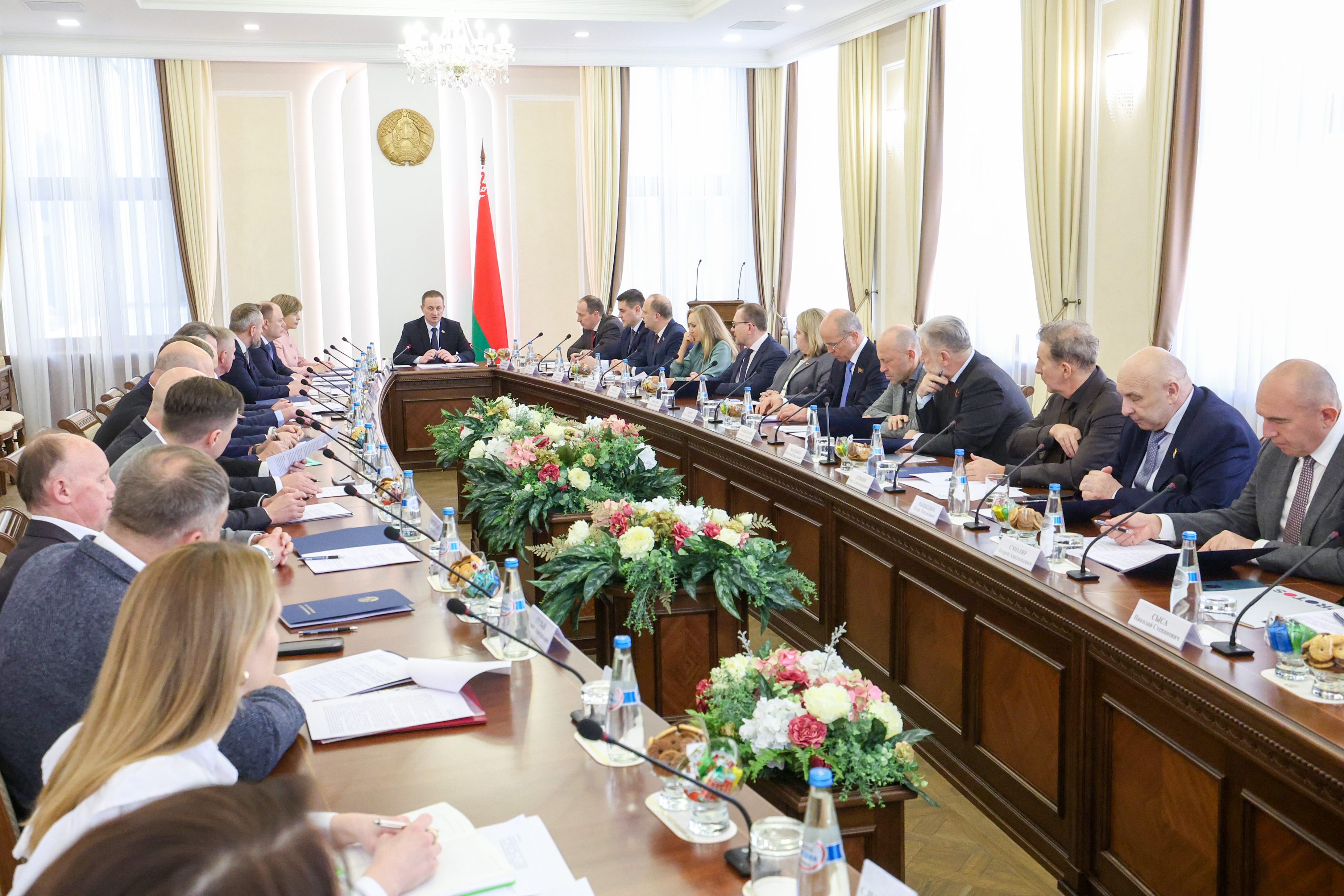
The Government hosted a meeting of the Entrepreneurship Development Council, chaired by the Prime Minister of Belarus, Aleksandr Turchin.
The key topic on the Council’s agenda is staffing for businesses and ways to improve labor regulation. The main issues for discussion include introducing flexible hiring mechanisms and enhancing opportunities for students to participate in the workforce.
“According to a survey conducted by the staff of the Council for Entrepreneurship Development, this issue resonates with nearly every member. We are talking about the availability of skilled labor, workforce quality, and issues of specialist training. So, we have a broad agenda ahead of us,” Aleksandr Turchin noted.
The Prime Minister pointed out that these issues had recently been discussed in great detail at a board meeting of the Ministry of Labor and Social Protection, where pathways for further progress were outlined.
Taking part in the Council meeting are the heads of relevant ministries: Minister of Labor and Social Protection Andrei Lobovich, Minister of Education Andrei Ivanets, and Minister of Economy Yuri Chebotar.
“The problem we are going to address concerns all participants in the process: both the regulator and businesses. We cannot handle this alone. We must clearly understand how we will act together to solve these important tasks,” the Head of Government stated.
According to Andrei Sidorov, a member of the Council of the Republic’s Standing Commission on Economy, Budget and Finance, today’s meeting focuses on labor legislation. “We need to identify the key points to discuss between government representatives and businesses. This is an excellent platform for dialogue between the Government and the real economy. Here, opinions can be expressed and concrete proposals put forward, which can then be effectively reviewed and utilized,” Andrei Sidorov believes.
As for education and personnel training, this is a key issue not only for Belarus but for all countries. “This effort must begin in school, which serves as the foundation not just for learning, but for upbringing as well. This process should involve not only teachers and education system workers but also representatives of the real economy. Interaction between both sides is necessary: enterprises should come to schools, and schools should reach out to enterprises. An active life stance is also important. Today, we have all conditions for this, including modernized enterprises that have advanced significantly,” he said.
Particular attention should be paid to career guidance. “Children should be introduced to the real economy as early as third or fourth grade, visiting facilities in healthcare, agriculture, industry, and other sectors. They need to see their parents at work and understand what the country needs. By the tenth or eleventh grade, a student should already be dreaming about their future job. If a child has a dream, they will choose the right specialty and stick with it. As a result, the specialist will be well-trained, and the real economy will gain a qualified employee,” Andrei Sidorov said.
“It can be said that currently, interaction is primarily between higher education and specialized secondary educational institutions. This process still lacks an active role for the real economy, and it is the real economy that should play a key role,” he stated.
Director General of the KOMPO machine-building enterprise Valentin Pikul mentioned that among the business initiatives at the council are issues related to student training and job placement. “We also need to separately address aspects of legislation concerning the preservation of engineering competencies, staff retention, and the use of effective motivation tools,” he noted.
At his enterprise, there is no debate about which specialties will be in demand: engineers are always needed. “The prestige of engineering is already obvious to many. It is very gratifying that a large number of young people are now choosing engineering. I want to tell them: you have definitely made the right choice” Valentin Pikul remarked.
The previous meeting of the Council for Entrepreneurship Development took place at the end of 2025. At that time, it was decided to hold meetings at least quarterly.